
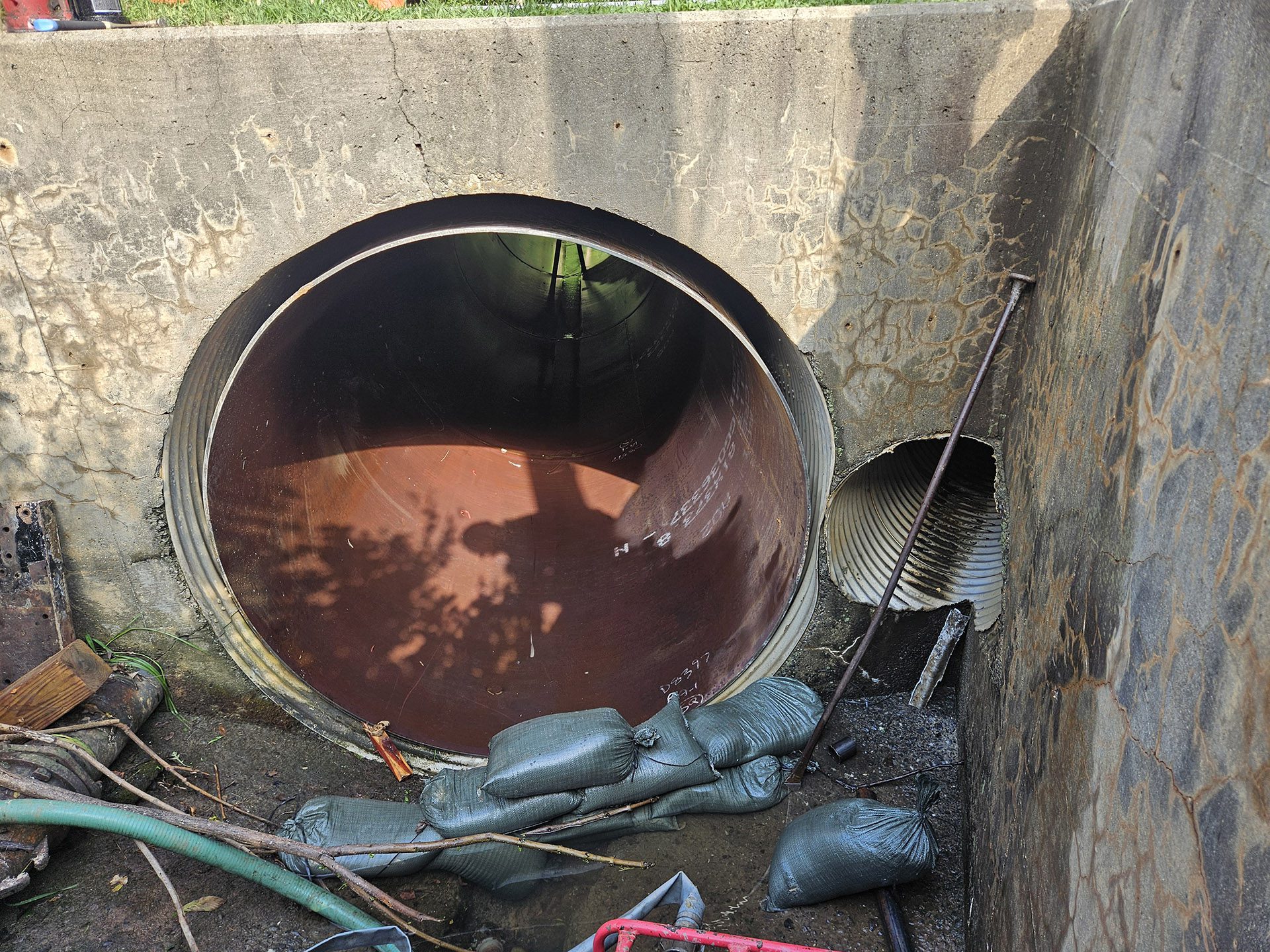
Corrugated metal pipe is failing faster than agencies can replace it, and the rehabilitation methods most commonly specified don’t actually solve the structural problem
A corrugated metal pipe installed under a state highway in the 1970s was designed for a 50-year service life, which means it should be reaching the end of its useful life right about now, and thousands of corrugated metal culvert pipes are doing exactly that. But there is a structural reality that most rehabilitation specifications do not adequately address: by the time an agency identifies a CMP as a candidate for relining, the host pipe has often lost so much wall section to corrosion and invert deterioration that it cannot contribute meaningful structural capacity to the rehabilitated system. The liner, whatever material it is made of, must carry the full earth load and live load on its own. That single fact should change every material selection conversation. In my experience, it rarely does.
I have spent years watching agencies specify rehabilitation methods that assume the host pipe will share structural duty with the liner for decades into the future, even when the field inspection clearly shows a pipe that is perforated, buckled, or missing its invert entirely. For example, at InfraSteel we have provided many culvert liners that were installed in culverts where the inverts were previously paved as the rehabilitation method. The result is a rehabilitated crossing that looks new after the invert was paved but is functionally underbuilt from the moment it goes into service. We need to talk honestly about what corrugated metal pipe failure actually looks like, which rehabilitation methods can handle a fully deteriorated host, and what kind of service life each method realistically delivers.
How Corrugated Metal Pipe Actually Fails
It is natural to picture pipe failure as a dramatic collapse, but CMP deterioration is usually slow, progressive, and deceptively quiet. The most common failure mode is invert corrosion, where the pipe’s bottom loses wall thickness from the inside out due to prolonged contact with water, abrasive sediment, and low-pH runoff. Galvanized coatings help initially, but Caltrans’ destructive testing has proved that galvanization erodes over time primarily from abrasion, and once bare steel is exposed the corrosion accelerates. A pipe that looks structurally sound from a drive-over inspection may have an invert that you can push a screwdriver through.
The second major failure mode is joint separation, which allows soil migration into the pipe, creating voids in the backfill envelope that can eventually undermine the road surface, leading to dangerous sink holes which are hazardous to the traveling public. The third is global deflection, where the pipe’s cross-section deforms under load because the corrugated wall has lost enough section to reduce its moment of inertia below what is needed to resist soil pressure. These failure modes often overlap, and by the time a pipe is flagged for rehabilitation it may be experiencing all three simultaneously. That matters enormously for liner selection, because a rehabilitation method that relies on the host pipe for ring stiffness is relying on a structure that may have very little stiffness left to offer. What was once a round CMP structure may have distorted to an elliptical shape, which requires an elliptical shaped culvert liner designed specifically to match the shape of the existing structure and handle the site’s load bearing requirements as a stand-alone structure.
The Question Everyone Asks First, and Why the Answer Is More Complicated Than It Seems
Can galvanized pipes be relined? Yes, but the word ‘relined’ covers an enormous range of methods with very different structural outcomes, and the galvanized coating on the host pipe is almost never the deciding factor. What matters is how much structural capacity the host pipe retains, what loads the liner needs to carry independently, and how long the owner expects the rehabilitated crossing to last. A thin spray-applied liner inside a pipe that still has 80% of its wall section is a completely different engineering problem than a structural slip liner inside a pipe that has lost its invert and is carrying a state highway with heavy truck traffic.
The question of how to repair a corrugated pipe is similarly deceptive in its simplicity. The answer depends on the pipe’s condition, the required design life, the hydraulic constraints, the depth of cover, and whether the road above can be closed during construction. Below, I walk through the four most common rehabilitation approaches and lay out what each one can and cannot do.
Four Rehabilitation Methods and What They Actually Deliver
The first method most agencies encounter is spray-applied lining, which involves applying a cementitious or polymer coating to the interior of the existing pipe. Spray lining is fast, relatively inexpensive, and effective at arresting corrosion in pipes that still have substantial wall thickness remaining. But spray linings are typically thin, in the order of a quarter inch to half an inch, and they do not add meaningful structural capacity. If the host pipe is already compromised, a spray lining will slow further deterioration but will not restore the pipe’s ability to carry load. The realistic service life extension for a spray lining in a moderately deteriorated CMP varies depending on water chemistry and abrasion conditions. For a pipe that still has decades of structural life left, that can be a smart, economical choice. For a pipe that is already failing structurally, it is a band-aid.
The second method is cured-in-place pipe lining, or CIPP, which involves inserting a resin-saturated felt liner into the host pipe and curing it in place with heat, UV light, or ambient conditions. CIPP has been widely used in sanitary sewer rehabilitation and has a strong track record in gravity-flow municipal pipe. In culvert applications, however, CIPP faces some real limitations. CIPP liners are typically designed as partially deteriorated or fully deteriorated condition liners per ASTM F1216, and a fully deteriorated design requires the liner to resist all external loads independently [1]. The challenge is that CIPP liners in large-diameter culvert sizes can struggle to achieve the wall thickness and ring stiffness needed to carry deep earth loads and HL-93 live loads without the host pipe’s help. There are also documented concerns about styrene leaching and installation quality variability that have drawn scrutiny from environmental regulators and from pipe manufacturers who have studied CIPP application risks in detail [2]. Service life projections for CIPP in culvert applications vary, and long-term performance data in large-diameter, high-load culvert environments is still relatively limited compared to smaller-diameter sewer applications. Consequently, the long term effects to CIPP lined culverts in highly abrasive environments is unknown.
The third method is sliplining with HDPE or PVC profile pipe, which involves pushing or pulling a smaller-diameter thermoplastic pipe through the existing host pipe and grouting the annular space. Slip lining with plastic pipe is well-established and can provide a fully structural liner that does not depend on the host pipe for load-carrying capacity. The trade-offs are hydraulic and practical. Because the liner must be smaller than the host pipe to fit inside it, there is an inherent reduction in waterway area, and the annular grout must be placed carefully to avoid voids. HDPE and PVC liners can deliver substantial design lives in many conditions, but their long-term performance under sustained earth load and cyclic live load in large-diameter culvert applications is a subject of ongoing discussion among structural engineers, particularly regarding creep behavior in thermoplastic materials under permanent load.
The fourth method is sliplining with smooth-wall carbon steel pipe, which involves inserting a site-specific steel liner into the host pipe and grouting the annular space. Steel slip liners can be engineered to carry full earth load and live load independently, with no structural contribution assumed from the host pipe, which makes them suitable for the worst-condition CMP rehabilitation scenarios. The smooth interior wall actually improves hydraulic capacity compared to the original corrugated pipe, partially or fully offsetting the diameter reduction inherent in slip lining. Steel liners can be designed for long service lives with calculated designed life based on the wall thickness providing sacrificial steel for each year of design life, and they behave predictably under sustained load because steel does not creep. The limitations are that steel liners are heavier than plastic alternatives, require more engineering up front because each liner is designed for site-specific conditions, and cost more per linear foot than spray lining or CIPP, though that cost comparison looks very different when you factor in service life.
The Framework That Should Drive Every Rehabilitation Decision
I want to propose a way of thinking about culvert rehabilitation that I believe would prevent the majority of underbuilt projects I see in the field. It has three components. None of them are complicated, but they require a discipline that the current procurement process does not always encourage.
The first component is rigorous condition assessment. The design engineer must determine whether the host pipe can be assumed to contribute structural capacity over the full design life of the rehabilitation, or whether the liner must be designed as a fully independent structure. I am oversimplifying the structural analysis, but the core question is binary and it changes everything downstream. If the host pipe cannot be counted on, then spray linings and thin-wall CIPP designs are off the table for structural rehabilitation, full stop. They may still serve a corrosion-protection role, but they are not structural solutions for a pipe that has already lost its structural integrity.
The second component is lifecycle cost analysis, not first-cost comparison. A spray lining with a lower installed cost but a shorter service life is not necessarily cheaper than a steel slip liner with a higher installed cost but a longer service life, especially when you factor in the cost of mobilizing equipment, managing traffic, and disrupting the road surface for a second rehabilitation in the future. Agencies that compare rehabilitation methods on installed cost per foot without normalizing for design life are making a math error that compounds across their entire culvert inventory. This is not a controversial claim. It is arithmetic. And yet I continue to see bid tabs that treat all rehabilitation methods as interchangeable line items.
The third component is a clear-eyed hydraulic analysis. Every slip-lining method reduces the pipe’s internal diameter, and the designer needs to verify that the rehabilitated pipe can still pass the design storm without causing upstream flooding or exceeding allowable headwater. What many engineers overlook is that a smooth-wall liner, whether steel or HDPE, has a significantly lower Manning’s roughness coefficient than the original corrugated metal pipe, which means the flow capacity reduction from the diameter decrease is partially or fully offset by the smoother interior surface. Running the hydraulic numbers before defaulting to ‘we can’t reduce the diameter’ often reveals that slip lining is feasible in crossings where it was initially dismissed, especially when beveled inlets are incorporated into the inlet design to improve flow rates and lower headwater.
What This Means for Agency Leaders and for the Engineers Writing the Specs
For agency executives and asset managers, the implication is that your culvert rehabilitation program may be systematically underbuilding rehabilitated crossings by selecting methods based on lowest first cost rather than lowest lifecycle cost. If you are rehabilitating 50 culverts a year with methods that deliver 20-year service lives, you are creating a second wave of rehabilitation demand that will hit your budget in the 2040s, on top of all the culverts that have not yet been touched. The agencies that will be in the strongest position 20 years from now are the ones that are specifying rehabilitation methods matched to the actual structural condition of each pipe and designing for 50-year or 75-year service lives where the crossing warrants it.
For the engineers writing specifications and reviewing submittals, the practical takeaway is to stop treating rehabilitation method selection as a procurement decision and start treating it as a structural design decision. That means requiring a condition assessment that explicitly states whether the host pipe is assumed to contribute structural capacity, requiring the liner designer to demonstrate that the proposed liner can independently carry the design loads if the host pipe cannot be relied upon, and requiring a lifecycle cost comparison that normalizes across design life. These are not exotic requirements; they are the same rigor we apply to new bridge design, and culvert rehabilitation deserves the same standard. When we are involved in the design process with the project owner or their consulting engineers, we provide HL-93 or E80 load calculations that determine a site specific liner wall thickness that meets the project owner’s design criteria as a stand-alone structure.
The Window Is Narrow and the Inventory Is Not Getting Younger
Federal infrastructure funding has been directed to state and local agencies for culvert and drainage rehabilitation work of exactly the kind I have been describing. The procurement decisions being made now will determine whether those dollars produce crossings that last for generations or crossings that need to be touched again within a decade or two. That is not a theoretical distinction; it is the difference between solving the CMP backlog and perpetuating it.
The question worth sitting with is this: when you specify a rehabilitation method for a corrugated metal pipe that has lost its invert and is carrying a road that matters, are you designing for the structure you actually have in the ground, or for the structure you wish you had? The pipe does not care what the spec assumes. It only knows what load it can carry, and if the answer is ‘not much,’ then the liner you put inside it had better be able to carry the rest on its own, for a long time.
The author is a senior executive at InfraSteel, where he has spent years working with transportation agencies, engineers, and contractors on the structural rehabilitation of deteriorated culverts and bridges across the United States. InfraSteel engineers site-specific smooth-wall carbon steel slip-liner systems for culvert, bridge, and railway rehabilitation from its headquarters in Birmingham, Alabama.
───────────────────────
References
[1] A Comparative Review of Trenchless Cured-in-Place Pipe … — www.frontiersin.org
[2] 5 Application Risks of Cured-in-Place Pipe Lining — www.charlottepipe.com


Leave A Reply