

Trenchless Technology called upon two industry experts to provide an overview of the stormwater market, looking at its status and the challenges and opportunities therein.
In some regions stormwater systems are an afterthought, but the smartest asset owners are proactive about maintaining and repairing their systems, says Cullom Walker, cofounder of InfraSteel, a division of Precision Pipe & Products.
The way to bring more attention to the needs of stormwater systems is by continuing to talk about the challenges to educate owners and the public alike, says Ahmad Habibian, Ph.D., P.E., vice president and global practice leader of conveyance, for CDM Smith Inc.
So, let’s talk about it.
To start off, let’s take a look at the status of stormwater systems in North America and, more specifically, the United States.
“Failing is the status,” Walker says. “The old structures that were put in, however long ago, 30 to 50 years ago are failing. With weather-driven events, those are times where it becomes very obvious. I can Google just about any day, certainly every week, I see sinkholes and highway failures.”
The departments of transportation (DOTs) and other governing bodies refer to these events as sinkholes, Walker explains, but it’s a sign of a failing culvert below ground.
“It’s when these weather-driven events create flooding and the failing culverts fail under roads,” he says.
Habibian refers to recent data from the American Society of Civil Engineers (ASCE) when assessing the condition of U.S. stormwater systems.
“In terms of the status of the stormwater market and conditions, if you look at the ASCE Report Card, it gives it a grade of D,” he says. “If you compare that with the grade of D-plus that they give to the wastewater sewer system, you can see that it’s one notch below.”
Like Walker, Habibian also highlights the challenge of weather-driven events impacting stormwater systems.
“The D grade is for the most part given because of the age of the system and its condition,” Habibian says. “But really what is exacerbating the situation now is the climate change effects, which is causing more frequent and intense rainfalls. That in turn causes significant flooding in urban areas, which is a big problem in many parts of the country.”
Habibian suggests that the increased occurrences in flooding makes the situation even worse than the ASCE’s D grade indicates.
“Not only do we need to be worried about the condition and the age of the sewer system, but now we also have to be worried about the capacity of the system, as well,” he says. “What we used to call a 10-year storm for design purposes today is not a 10-year storm anymore, and probably it’s a five-year storm or even a two-year storm.”
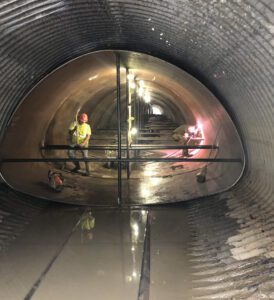
Walker stresses the need for stormwater system owners to stay ahead of the problem.
“The smarter entities, whether they’re the government, counties, departments of transportation or private tollway operators, the smart ones know they need to be fixed, and they need to be inspected,” he says.
Walker gave one example of one these “smart ones,” a turnpike operator in the Northeast that he didn’t want to name in this article, which has a “very active inspection program.”
“At this time of year [summer], there will be multiple contractors working up and down the [redacted highway name] fixing the culverts that are failing,” Walker says. “They understand the importance of that. If you have a failure, you lose. It’s economics for them too, right? Because they’re a tollway.”
A failure that detours traffic, not only takes paying customers off the roadway, but it can be a major inconvenience for the public that might have to drive 20 miles or more out of their way to get around the obstruction. In some case, Walker says, the detour could negatively impact public safety, forcing first responders and emergency personnel to take a longer route.
“I’ve used the analogy before,” he says, “do you want your kid to be the one in the ambulance that’s got the 20-mile detour?”
Funding Falling Short
Referring back to the ASCE Report Card, Habibian says that the stormwater market in the United States is facing an $8 billion funding gap. So where can system owners find the cash needed to fix these problems?
“There are some limited opportunities available through the Clean Water State Revolving Fund (CWSRF), through the Water Infrastructure Finance and Innovation Act (WIFIA), through the Bipartisan Infrastructure Law (BIL), and the Inflation Reduction Act,” Habibian says. “However, these fundings are way below the annual $8 billion gap. The major source of funding for stormwater projects comes from user fees and states have different structures. For example, where I am in Fairfax County, Virginia, they have a stormwater fee of 4 cents per $100 of appraised property value. In California, under Measure W, L.A. County has a 2.5 cents per square foot of impermeable area.”
The funding challenges facing the stormwater market aren’t unique.
“We have the same issue with all kinds of infrastructure, both the water, wastewater, bridges, and really what you have to do is improve the understanding of the public about the need to invest,” Habibian says. “The public is very much sensitive to when they see bridges collapse, like what happened a few months ago in Baltimore, for example. Everybody saw that and said, ‘Well, yeah, definitely you should put I don’t know how many billions into rebuilding this bridge and also improving the condition of other bridges.’ It’s important that the citizens get educated and informed about the need of that investment [for stormwater infrastructure].”
Stormwater Fixes
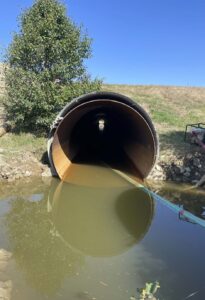
Walker is a firm believer in rigid products for repairing stormwater systems, citing the steel-based InfraSteel product as well as plastic pipe lining systems.
“Our belief is when it’s properly engineered, slip lining with a rigid liner is basically a new installation,” Walker says. “Slip lining itself is a method for installing a new culvert. It’s almost like more than rehab.”
Walker adds that “of course it’s rehab,” but in the effort to educate people, he says that slip lining, along with other design elements to improve hydraulic capacity, such a beveled inlet or flow bell, can ensure that the repaired culvert performs as well or better than the original installation while adding to the design life of the structure.
In addition to slip lining, Habibian highlights spray-applied cementitious or geopolymer materials, spiral wound pipe and cured in place pipe (CIPP) as popular solutions.
“Other methods used for sewer systems rehabilitation, such as pipe bursting, are also applicable and may be considered for specific cases,” he says.
Making an Assessment
Assessing stormwater systems is an important step in maintaining and prioritizing rehabilitation and replacement projects, Walker says. There are many tools available for owners to conduct inspections, but the most common asset is people.
“Quite frankly, most of them when they’re inspected are inspected by individuals,” Walker says. “There are robotic inspection systems. It’s sort of a bleed over from the smaller diameter market where humans can’t get in the pipes. But in most cases for culverts, it’s just somebody taking the time to go out there and look at them.”
Walker highlights Lidar as a helpful technology for engineers performing assessments to survey stormwater structures. One of the biggest areas where Lidar can be useful is assessing the shape of a pipe that may have incurred deformities over time, which can cause failures.
“If it’s corrugated metal, for instance, you might have a big sag in the top. That’s one of the things that Lidar picks up on,” Walker says. “And if somebody’s not using Lidar, then we use measuring lasers and things like that to ferret out what’s going on inside of there so that we can make a liner that’ll fit.”
Habibian agrees that visual inspections, along with CCTV, are the most common methods of inspecting stormwater systems.
“Laser profiling is also common,” he adds. “Any other method used for sewer system inspection, such as GPR for detecting voids, can be applicable as well.”
Walker says that proactive asset owners are constantly monitoring their stormwater systems, conducting physical inspections, and looking out for telltale signs of imminent failure, such as dips in the highway or railroad lines.
“We try to tell owners when doing presentations that that’s something that their maintenance crews can look out for when riding down the road,” he says. If there is a dip in the road or railway, it could be a sign of a failing culvert underneath the structure.
Education Opportunity
Walker and Habibian agree that the industry has done good job in educating system owners about the trenchless solutions available to the stormwater market.
“Obviously, education is not a one-time deal, and we need to continue providing ongoing education opportunities for system owners,” says Habibian, who reiterates that the bigger issue is educating the public about the importance of investing in improvements to stormwater systems as well as what they can do to help to minimize the volume of stormwater at the source.
“It’s not like, OK, you do a webinar here or a presentation there,” he says. “It has to be ongoing.”
The public needs to understand its own role in mitigating capacity of stormwater systems, Habibian says. Many issues stem from buildings and all the impervious areas that we as a society are producing. The use of permeable pavements and managing roof water runoff can go a long way toward solving these challenges.
Challenges, Opportunities
While there are many challenges facing the stormwater market, Habibian and Walker also highlight the many opportunities available.
“Obviously, inadequate funding is the biggest challenge,” Habibian says. “As I mentioned earlier, climate change effects are another big challenge that tests the resilience of stormwater systems. Another challenge is that some owners don’t have a good handle of what they are facing. They lack having a holistic approach to tackle the problem.”
Habibian explains that having holistic approach means an “asset management philosophy” that sets a framework for creating an inventory of the stormwater system, its location and condition, and prioritizing the problems that need to be fix within the allowable budget.
“Asset management is probably the opportunity for many of these stormwater utilities to embrace and use that as an approach to move forward other opportunities,” he says. “One of them of course is digital technologies mostly for monitoring of the systems, not only their condition, but also the amount of flow in different places.”
Having a dedicated stormwater utility can also benefit regions, Habibian says, by providing a “focal point for addressing the funding needs” for the system and implementing asset management solutions.
Walker says that the “smart” asset owners are taking inventory of their stormwater system and working to keep up with failures, and that’s from where he sees the majority of his business coming.
“My opportunity is with the smart owners because the dumb owners aren’t going to … fix anything,” he says.
Despite some owners not keeping up with maintaining their stormwater systems, Walker describes the market as full of opportunity.
“After focusing on this market for the last 15 years or so, I just think it’s such a huge market that we have in front of us,” Walker says. “The world is our oyster. If you’re wanting to go fix failing culverts, whether you’re a supplier, contractor or an engineer that wants to specialize in that type of thing, I think it’s awesome.”


Leave A Reply